

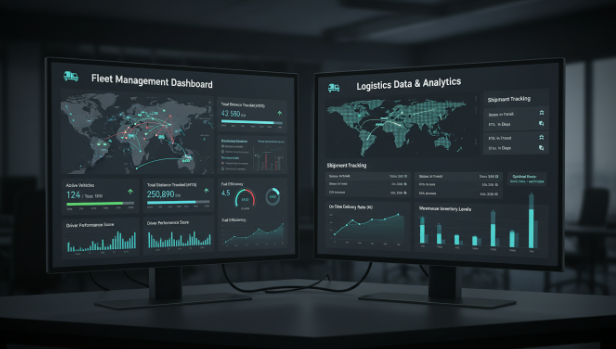
Ten years ago, most fleet decisions came down to a manager’s experience and a few spreadsheets. Truck needs maintenance? Check the mileage log, follow the schedule. Driver seems to be burning more fuel? Talk to them about it next week. Customer asking where their shipment is? Call the driver and relay whatever they say. None of this was irrational. It was just limited by what was knowable at the time.
What changed isn’t that fleet managers suddenly got worse at their jobs. What changed is that the trucks started generating data at a scale that made gut feel look reckless by comparison. A single modern commercial vehicle produces thousands of data points per day — engine temps, oil pressure, fuel consumption rates, GPS position, speed, idle duration, braking events, transmission behavior, coolant flow, exhaust gas patterns, battery voltage. Multiply that across a fleet of 80 trucks over a year and you’re sitting on a volume of operational information that no person could process manually, even if they tried.
The fleet management market grew from roughly $27 billion in 2025 to a projected $122 billion by 2035. That kind of growth doesn’t come from better GPS dots on a map. It comes from the data layer that sits on top of tracking and turns raw signals into decisions about maintenance, fuel, safety, compliance, and asset planning.
The difference between having data and using data
Plenty of fleets have data. Telematics devices are installed. ELD systems are running. Fuel cards are generating transaction logs. GPS is pinging every 30 seconds. The data exists.
The problem is that most of it sits unused. Only 23% of fleets use big data analytics to guide strategic decisions, according to industry research. Another 15% are planning to get there eventually. That leaves the majority collecting data through various systems and doing very little with it beyond basic tracking and compliance reporting.
The fleets that have pulled ahead aren’t the ones with the most data. They’re the ones that connected their data. When fuel consumption, driver behavior scores, engine health telemetry, route performance, and maintenance history feed into the same analytical layer, patterns become visible that no single data stream could reveal on its own.
A truck burning more fuel than expected could be a driving behavior problem (aggressive acceleration), a maintenance problem (worn injectors), a routing problem (new construction zone adding stop-and-go time), or a combination of all three. On disconnected systems, the fleet manager sees the fuel number and starts guessing. On a connected platform, the system correlates fuel data against driver scores, engine diagnostics, and route changes, and tells the manager which factor is driving the variance. That difference — between guessing and knowing — is what data transformation actually looks like in fleet operations.
Where data makes the biggest operational difference
Maintenance scheduling has shifted the most. The traditional model — service every truck on a fixed mileage or time interval — treats every vehicle the same regardless of how it’s actually being used. IBM research found that 30% of preventive maintenance visits are unnecessary. The truck gets pulled into the shop, a technician inspects it, nothing needs attention, and half a day of productivity is lost because the schedule said it was time.
Data-driven maintenance replaces that with condition-based scheduling. Continuous monitoring of engine and component behavior builds a profile of what normal looks like for each truck under its specific operating conditions. When readings drift from that baseline, the system flags it weeks before a diagnostic trouble code fires. A municipal fleet of 1,400 vehicles ran this approach and caught faults in 30% of their trucks before any DTCs appeared, saving roughly $500 per vehicle per month in avoided breakdowns and unnecessary shop visits.
The shift from scheduled to condition-based maintenance represents the clearest example of how data changes outcomes. It’s not that fleet managers didn’t want to service trucks at the right time before. They just didn’t have a way to know when the right time was.
Fuel management is the other area where connected data changes the economics significantly. Fuel is 24-40% of operating costs for most fleets, and the waste embedded in that number is surprisingly high. Excessive idling, aggressive driving habits, undetected mechanical issues that reduce engine efficiency, and in some cases outright fuel theft — these all eat into the fuel budget in ways that show up on the monthly report as undifferentiated “fuel cost” rather than as specific, fixable problems.
When fuel data connects to GPS, engine diagnostics, and driver behavior scoring, the fleet manager can see that Truck #14 is burning 18% more fuel than Truck #15 on the same route because the driver’s hard-acceleration frequency is twice the fleet average. That’s a coaching conversation, not a mystery. Platforms that integrate fuel analytics with engine health and driver performance data consistently deliver 10-20% fuel cost reductions, mostly from making waste visible and addressable at the individual truck and driver level.
The logistics side of the equation
Fleet data transformation doesn’t stop at the truck. It extends into how logistics operations plan, execute, and adapt.
Real-time vehicle tracking paired with engine and load data gives logistics companies the ability to provide accurate ETAs based on actual vehicle speed, traffic conditions, and remaining route distance — not the estimate the driver gave two hours ago. This has become table stakes for shippers and receivers who build their own staffing, dock scheduling, and production planning around delivery windows. A fleet that can’t provide reliable, data-backed ETAs is at a competitive disadvantage against one that can, regardless of price.
The bigger shift is in how logistics companies handle exceptions. Traditional exception management was reactive — something went wrong, someone called, someone scrambled to fix it. Data-connected fleets handle exceptions predictively. A truck running 40 minutes behind schedule triggers an automatic notification to the customer and to dispatch, along with a revised ETA calculated from current speed and remaining route. A truck showing an engine temperature trend that suggests a possible breakdown risk within the next 48 hours gets rerouted to a service facility that’s along the current lane rather than continuing on a route that might strand it.
These aren’t hypothetical scenarios. Fleets using integrated telematics with AI-driven analytics for daily operations report measurable improvements in on-time delivery rates and significant reductions in the kind of cascading failures that happen when a single breakdown disrupts an entire day’s schedule.
What “data-driven” doesn’t mean
Worth noting what this transformation doesn’t look like, because the vendor marketing around fleet data can be misleading.
Data-driven fleet management doesn’t mean replacing human judgment with algorithms. The fleet manager still makes decisions. The data changes what those decisions are based on — evidence instead of guesswork, patterns instead of anecdotes, per-truck specifics instead of fleet averages. The best fleet managers using data-driven platforms describe it as having their instincts confirmed or challenged by information they didn’t previously have access to, not as being replaced by software.
It also doesn’t mean buying a platform and immediately seeing results. Fleetio’s 2026 State of Fleet Management survey put it clearly: the fleets that outperform aren’t necessarily the ones with the most expensive technology. They’re the ones with the most disciplined processes — consistent data tracking, clear triage protocols, and fast action on what the data surfaces. A $500/month analytics platform that nobody acts on produces worse results than a $50/month GPS system that someone uses every day.
And data-driven doesn’t mean drowning in dashboards. The real value shows up when the system surfaces exceptions — the specific trucks, drivers, routes, and maintenance items that need attention right now — rather than presenting every data point for someone to manually sift through. A fleet manager looking at 80 green dots on a map isn’t making better decisions because of data. A fleet manager looking at three flagged trucks with specific alerts and recommended actions is.
Where this goes from here
The commercial vehicle telematics market is projected to exceed $130 billion by 2030. Nearly half of fleet professionals plan to implement AI-powered predictive maintenance by end of 2026. The installed base of active fleet management systems in Europe alone is expected to grow from 18 million to 30 million units by the end of the decade.
The trajectory is clear, but adoption is uneven. Large enterprise fleets have already made this transition. Small and mid-size operations — the ones that make up the bulk of the industry — are at varying stages. Some are running full predictive analytics platforms. Others are still reconciling fuel cards against spreadsheets every month.
The gap between those two groups grows wider every quarter, not because the technology gets more expensive (it’s actually getting cheaper), but because the operational savings compound over time. A fleet that started condition-based maintenance two years ago has two years of vehicle-specific baseline data making its predictions more accurate. A fleet starting today has to build that baseline from scratch. The data advantage isn’t just about having better tools. It’s about accumulating the intelligence that makes those tools more effective the longer they run.